Thursday, August 27, 2009

Resisting Rust Dyes

Over the past two days I've been experimenting with rust and tannin dyeing using resists. I choose three types of resists, clamp resist, preprinted white fabric, and Elmer's Glue Gel resist. I also wanted to see what would happen with a piece of brocade table cloth.


This first piece is a clamp resist vintage napkin. I knew that the rust uptake would be difficult because of the way I clamp (accordion fold to about 1 1/2 inch width, then double over, then put clamps at 1/4 inch intervals along the piece), so I sprayed the fabric with vinegar and sprinkled small bits of steel wool over the surface before I folded it. I poured strong tea over it after 24 hours and let it sit for four more hours.


This is the brocade. The color variation is very slight, and probably more about rusty object placement than about the brocade, but the effect is still nice.


I found these rusty looking fetish bears at Marco's in Dayton on the sale table, so I thought I would see if they created a pattern. I'm not sure they were effective, but I think I'll try clamping them and seeing what sort of resist I get.
These are both white on white polka dot fabrics. The photo shows both the front (on bottom) and the back of the fabrics. The one with the smaller dots was rusted with the new fluted cast iron muffin tin that I got from the quilter's garage sale last week. The larger dots were wrapped around the iron rake. I really like the patterns and I can't wait to put some Radiance on it. I put tea on these for four hours.


These last three are glue resists. I had some problems with this. First, on the two outside pieces (far left and far right) I applied the glue freehand and much heavier than the one in the middle with the circle stencils (you can tell by the circular circles as opposed to the ovoid messes that I draw when I'm working freehand). I pole wrapped the one on the left and wrapped it in Saran Wrap. The glued places stuck to each other in some areas, so I got some ripping. Not a bad thing, but I probably won't pole wrap anything glued again. The stenciled circles in the middle I put on the wire basket and then I covered it with steel wool and some other rusty objects to get more even rust. The final piece I folded in a rusty pan with rusty objects between each layer. If folded the fabric over so you can see the difference between the side with the glue (the Radiance side, the one on the bottom). I think I will glue on the cotton side next time, as I like the more subtle pattern on the reverse.

I put tea on these for four hours. My problem was with the ones that had the heavier glue application. Everything I read lead me to believe that the glue would come out easily. But I didn't find that to be the case. I washed and scrubbed the fabric with my hands and with a scrub pad in hot water three different times and it didn't come out. Then I ran it through the washer three times. I think it's finally mostly gone. Where there was glue in some places the fabric is stiffer. I did find the removal process frustrating. Soy wax or beeswax would probably have come out more easily though they would have required more set up. I like the resists, and I think I'll try to do some more clamped and then clamped again and overdyed.

Bonus: For this piece, I put the planting plate on the bottom, then a patterned piece of metal, and then a planting plate on top. Each of these had layers of fabric between them. In this picture, you can see how the pattern is picked up within the planting plate. Yum.

What to try next? I'll go back to Ann Johnston's and other surface application books and see if I'm missing any other possibilities here. I think I'll try more of the shibori resists with steel wool captured between the layers to see if I can duplicate some results that others are getting. I'm also tempted to see how the iron sulfate works. Oh, I did dye a ribbed T-shirt, but I'll post it after I get someone to model it for me.

Tuesday, August 25, 2009

Rusty Scrap Quilt--50th Post Contest

As I was cutting off the edges to my weekly quilts, I couldn't bear to throw the beautiful pieces in the trash, so I decided to use Pauline Burbidge's (and others, I'm sure) method for joining quilt sections with a zig-zag stitch, then I edged it with a loose zig zag. I also drew circles in several places with a zig-zag stitch to tie the pieces together. I think this would be nice attached to mat board (turquoise maybe?) and framed. Anyway, it was quick and fun and I like the way it looks. I might add some more zig-zag circles. Let me know what you think.

Oh, and I just realized that this is my fiftieth post. To celebrate, I'm going to give away six fat eighths of my hand-dyed Radiance fabric. You can see the colors in the earlier post. Just post a comment, and I'll draw names on Friday and contact the winner for her/his address and then send them out. Thanks for helping me celebrate.

Monday, August 24, 2009

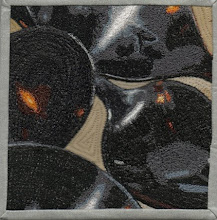
August Week 3: Wheels of Time III, 6x6"

I've finished my August quilts using my rust dyed fabrics. Many of the fabrics I used are repurposed--fabric cut off the bottom of curtains, etc. I've also used some vintage textiles that I picked up at Goodwill and garage sales.

I'm enjoying the techniques that I'm using, just layering the fabric and then sewing. I think it fits the more ethereal nature of this fabric. I also really enjoyed using the napkin edges on the vintage linens.

August Week 4: Wheels of Time IV, 6x6"

I've struggled with knowing how to quilt these quilts. Quilting too heavily makes it seem too fussy. I have a 2" steel washer that's been hanging out on my design wall, and as I was working on this quilt today, I looked up and thought, "Ah-ha." I drew around the washer and then quilted those lines. I like the look, and I think that it will translate well into the larger quilt I'll be working on soon (Well, as soon as I start working big again).

Friday, August 21, 2009

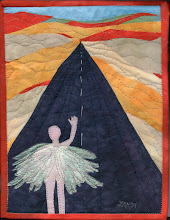
July Spiritual Challenge: Trust


Trust
12 x 12"

Someone sent me the e-mail story that's going around about the wealthy guy who stops to pick up pennies on the street because the statement "In God We Trust" reminds him to pray. I sent the story to my husband, who was moved by it. Sometimes when I call him up, he'll say, "I've found a lot of pennies on the ground today." It's shorthand for the fact that he's having a tough day but that he knows he isn't alone in having to deal with it.

Of course, on all American currency there is the statement, "In God We Trust." Many people who pass the currency to each other don't really have that trust in the God that the founders of the country envisioned, but most of them have faith in something. In money itself, in their families, in work, in play, in the absence of belief, etc. I chose to focus on the word Trust in this quilt to both honor my own spiritual practice and beliefs (I do trust in the God of my understanding), and to honor the spiritual beliefs of everyone who handles money everyday.

I've always picked up pennies when they are on heads, given them an air kiss, and then put them in my shoe (or my purse as I'm often wearing flip flops). Even when my own faith was at a low point, I still trusted in "luck." So this quilt also honors the journey of my spirit. I'm glad that I challenged myself to complete these spiritual quilts each month. It has made me look at my beliefs in new ways.

Tuesday, August 18, 2009

Just for Fun

Cupcake
8.5 x 11

This journal quilt was inspired by my friend Pam who suggested that "frosting" was a perfectly fine submission for our Art Quilt Network challenge "frosty." I asked permission before I stole her brilliant interpretative idea, and I had fun putting this together using a modified (in other words taken from a blog and not from her video) version of Elkins' portrait process. And though it isn't quite round here, since we all know that cupcakes are usually round, I decided it fits with my circle theme (not to mention the circles in the background fabric and in the white on white fabric).

I used a Simplicity fabric marker thinking that it was one of those that just disappeared. Nope. Instead I had to hand wash it and scrub like the dickens to get all those little purple lines off. I think I like the texture that it created when the batting shrunk a bit.

I'm almost to my 50th post, and I'm trying to think what type of giveaway I'll have to celebrate. Maybe some rusted Radiance, maybe fat eighths of some of my hand dyes, maybe some embellishments. Hmm, I guess you'll have to wait until I decide to find out.

Saturday, August 15, 2009

August Weekly Quilts 1 and 2

July Week One: 6x6"

Okay, so week one is a bit late, but I wanted to use the rusted fabrics I've been working on, so here it is. In addition to using the rusted fabrics, I'm trying a new applique technique. Instead of fusing or basting or anything really, I just laid down a 7" square piece of batting and layered fabric on top. I like the improvisational nature of this technique, but I think it would be tough on a larger quilt (though I plan to try it).

Every piece of fabric in the quilt is rust dyed, much of it is recycled vintage linen that I picked up at Goodwill and then rusted. I haven't posted my lavender experiments, but you can see two pieces of that fabric in this quilt, the background in the top right hand corner and the circle in the bottom left.

I did have some issues with needles and the fabric, especially since it's layered rust dyes in some places. A jeans needle helped, but part of the problem seems to be that the needle gets tired quickly. I don't have a microscope, but if I did, I'd probably find a lot of burrs on the needle, created by contact with the metal now embedded in the fabric.

July Week Two: 6x6"

Does the fact that week two is early make up for the lateness of week one? Again, you can see the purple fabric in the upper right. I used itajame shibori to make the pattern, clamping two half circles at the edge of the folded fabric. Some of the fabric is Radiance, some is sheer, some is recycled.

I'm trying to make these quilts about the design and not the fabric, and I'd love to hear feedback on how well you think I'm doing. Thanks.

Friday, August 14, 2009

Overdye and Quilt National

This morning, since I was up at 4:30 am seeing off my husband and son on their grand adventure to Boston, I decided to stay up and overdye some of the rust-dyed cloth that hadn't turned out as intense as I would have liked.

I used a variety of shibori techniques. I clamped several pieces, and I spiraled and scrunched others.

All of the fabrics had been washed in Synthrapol and dried before I set them up to dye again.

I mixed a little bit of cobalt blue in with the turquoise to dampen down the color a bit. The colors in the photos on my computer are fairly true. Who knows what will happen on yours?

For the top piece, I just scrunched the fabric a bit in the bottom of a gallon ice cream jug. I didn't stir it much, but again, the color is a little too even for my tastes. Where are my yogurt containers?

The second piece down is a bit of Radiance that I folded on the diagonal. I used two circles cut out of plastic ice cream lids and clamped them onto the fabric with clothespins.

The third piece is just a bit of 100% cotton that I spiraled the same way I would if I were doing a spiral tie dye design. Again, there is less variation in intensity than I would like. I think I'm probably using a bit too much dye concentrate, so I'll try less concentrate with the purple (4T to a cup for this batch, if you're keeping track).

The fourth fabric down was folded on the diagonal and then clamped with big binder clips. The bottom fabric was folded and then clamped with rectangular shapes cut from plastic and held in place by mini wood clamps.

I love the two colors, and in addition to lavender and rust, turquoise and earth tones were two favorite color schemes at Quilt National in Athens, OH. Once I'm done with this, I'm off to finish some rust I started this morning before heading out to Athens, hoping that some of it will not be very interesting so that I can overdye it lavender.

I put the fabric in the washer just in time to meet Pam out at Macy's car for a trip to Quilt National. The show was beautiful and rich and varied. I think 20% or more of the quilts used silk, and I noticed that whereas many of the quilts I see reproduced in magazines are heavily stitched, most of these quilts were stitched lightly, sometimes even invisibly.

There was a good deal of hand work, but some of it seemed to have been worked on the fabric before it was layered. Macy said that it seemed to her that many of the quilts used hand-dyed or hand-made fabric. I didn't notice it at the time, but I think, in retrospect, that she was right. Even if they weren't hand dyed, I did notice that many of the fabrics seemed to be more solid. I saw very few "quilting cottons" of the type you might get at your local quilt shop or crafts store.

Some of the most interesting quilts, to my mind, were ones that used transparencies in interesting ways. I also noted that a lot of the quilts were quilted and then somehow cut after they were made. Sometimes slashed, sometimes with sections cut away.

It was a beautiful show, very inspiring, and lunch afterwards at The Village Bakery and Cafe at 268 E State Street in Athens was a treat.

Thursday, August 13, 2009

Rust Never Sleeps, Especially if it Drinks Too Much Tea

So the next step on my rust dyeing adventure was to add tannin to the mix.

In much of the tannin/rust cloth I've seen, I didn't like how the rust was overpowered by the blue/grey/black of the tannin stain, but I'm pleased with the results of my experiment.

I let the fabric sit in vinegar and salt with the rusty metal during the heat yesterday afternoon and then overnight (about 18 hours). When it was mostly dry this afternoon, I poured the tannin water over it. In some cases, I poured just enough water to dampen it, and in others I let the cloth and the rusty object sit in the tea. I left things like this for about 4 hours. Then rinsed, washed, dried, and pressed.

To make the tannin, I used eight iced tea sized bags (decaf, Kroger store brand). I let them come to a boil in a large pot of water (about a gallon);then I let them sit for an hour.

For these fabrics, I used just a collection of cottons and white synthetics that I had in my dye bin. Some of the synthetics were just white fabric I'd cut from the bottom of curtains and sheers.

Oh, and I also dyed a bit of embroidery floss with rust so that I can hand stitch. It turned out a nice rusty shade, so I think it will do well with the hand work I'll do on whatever object these fabrics become.

Right now, I have some vintage linen and a tablecloth of undetermined material with cotton embroidery in the rust dyeing pans.

I'm not quite finished playing with rust; after all, I still have some white fabric left. I'll continue to rust dye, and I'll also overdye in turquoise some of the pieces that didn't turn out as deep as I would have liked. I'll also rust/tannin dye some Radiance this weekend to see how the silk takes the tannin. Finally, I found some rusty flashing, so I'm going to get out the drill press and see if I can make a rusty/holey piece of metal to dye with.

Oh, the circular plates that I've been using to rust the circles are called corn planting plates. You can do a search online, but many of them I see there have some heavy coating on them, so I assume you'll want vintage ones if you're looking for them.

The sources of rust from these images (top to bottom) are railroad spikes, planting plates, the tines of an iron rake, a 1.25 inch flat iron plate that's about 1/8 inch thick and 4 feet tall, horseshoes,and a collection of washers and 1/4 inch steel bars and scraps that were left over in the previous owner's shop and garage.

Tuesday, August 11, 2009

Rust Dyeing

Here's a side by side picture of Radiance and cotton rust dyed. (Radiance is on the left.) On first glance, the Radiance seemed to be crisper, but you can see here, that the cotton produces a crisper image. The Radiance, however, produces a deeper rust color in a shorter period of time.

Most of the info I've read says that you should use vinegar or salt and water, but I get the best results using both. I spray the vinegar and then I sprinkle a little salt. Heat makes it speed up, and getting things just damp and not saturated seems to make the process go more quickly. So does heat and humidity, so it's fortunate that I started this on the two hottest days we've had in Ohio this year.

Several people have asked about the object I used for the rust. I think it's a threshing plate. Once upon time, my husband made clocks out of these gear looking thingies, and my stepfather Tim, whose family own Hetrick Farm Supply in New Bethlehem, PA passed these on to us. They've been sitting and rusting in the workshop for about eight years, so they are nice and rusty. You can see the gear somewhat clearly in the picture above. This is just after the cotton has been sprayed with vinegar, full strength.

The universe has also gifted me with a hundred year old house whose previous owner had a machine shop in the garage and casual cleaning habits. (His and mine, after all, we've been here a year). In our barn style garage, there are plenty of rusty items as you can see from this shot. What more could a fledgling rust dyer ask for?Here's a collection of some of the cotton I've dyed so far. Some of these, I'll put out in the rust again to deepen the patterns and colors. I have some bar wrapped pieces and the one a little to the left of the center was wrapped around a broken iron rake.

It's raining now, but once the sun comes back out, I plan to see how rust and tannin mix. The tannin I'll use will come from two iced tea size bags in one cup of water, but I'm thinking of trying it in different dilutions to see what kind of variation I get. I'm wondering if the tannins will attach to the rust that I've already stopped with washing soda or if it will just attach to the new rust. Hopefully, it will be hot again today. (And I live in a house without air conditioning, so that tells you how much fun I'm having with this--I don't mind being hot so long as my rust dyes can develop nicely. The sacrifices we make for art ;-).

Monday, August 10, 2009

Radiance and Rusted Radiance


This weekend, I worked on some more dyeing. I had heard about the fabric Radiance PFD by Robert Kaufman and wanted to see how this 55% cotton/45% silk fabric would take both Procoin dye and rust.

On the left, you can see the results of three buckets that I dyed using my own mix and Ann Johnston's Value Parfait recipe guidelines.

I love the sheen and the colors, but I notice that since the silk has more sheen, and probably since the silk absorbs color differently, there isn't as much variation as there would be in 100% cotton dyed with the same recipes and stirred in the same manner. You can see this most clearly in the mid and deep range values of the green and the red.

Lessons learned:
--Stir less,
--Mix the dyes in more widely varying mixtures,
--Use smaller buckets. Something more along the lines of a large yogurt cartoon would be better than the 1 gallon ice cream buckets I usually use.

On the right are two small pieces of radiance that I rust dyed. I love the way the radiance takes the rust. It lifts the rust more quickly and it takes it more crisply than the other cottons I've tried.

If you've played with Radiance and have any tips to share, I'd love to hear them.

Saturday, August 8, 2009

July Weekly Quilts


After guests, cooking at summer camps, and some travel in July, I'm just now finishing my July weekly quilts. The design called for hand-dyed fabrics (mine) but I had to dye new fabrics as I didn't have quite the colors I wanted. I also tried to make the small quilts connect together across the weeks. So, if you can picture it, the top quilt, if moved to the left of the quilt underneath it, would extend the design of the second quilt and so on. I tried to make this work both if you were viewing them 1-4 horizontally and also if you were seeing the quilts in a square, 1 and 2 on top and 3 and 4 beneath. It sort of works.

I also did some rust dyeing this week, and I really like the results and the spontaneity of the process. I'll be working on my rust dyed cloth this week, and I'll share the results once I have a few samples.