Saturday, March 21, 2009

The Virgin of Guadalupe of Mission San Diego de Alcala


Soon after the Miami Valley issued the Southwest challenge, I went to San Diego and toured the beautiful mission there. In a small niche towards the front of the sanctuary sits a beautiful carving of the Virgin of Guadalupe. I lived in New Mexico, and the story of this localized icon has always been compelling to me, so I decided to use this image as the source of my January 12x12 spiritual challenge quilt.

I've used many of the common tropes used for the Virgin's presentation. She is often pictured in a way that looks as if she's standing on Juan Diego, but notice that his arms are outstretched as if he's lifting up his cloak with the vision of her on the back. Her gown is cut from a fabric that depicts roses in full bloom, like the flowers he brought to the bishop. The rays of light coming from around her are also traditional, as is the blue robe. Some other visions of Mary have her wearing the celestial robe, and I've duplicated that here.

I've added other images, too. The top quiltlet is of the ocotillo. This thorny native to the Mexican and American Southwest deserts sprout lush red blooms after rainfall. It's one of my favorite desert plants, and it's the most exuberant red bloomer in the desert, a reference to the roses Juan Diego brought to the bishop and to the crown of thorns. The next quiltlet is the bell tower at the Mission San Diego de Alcala. The third quiltlet from the top is the Virgin standing in a field of grain to symbolize how her gift of faith to the indigenous people also provided sustenance for their bodies. The lowest quiltlet is a bit of a reference to the goddess faiths around the world. Many see the Virgin of Guadalupe as a syncretic link between the new religion offered by the Catholic Spaniards and the female deities of the old indigenous religions of Mexico and the Aztecs.

More about the Virgin of Guadalupe

Wikipedia describes the Catholic accounts of the miracles like this: " According to official Catholic accounts of the Guadalupan apparitions, during a walk from his home village to Mexico City early on the morning of December 9, 1531,[1] Juan Diego saw a vision of a young girl of fifteen to sixteen, surrounded by light. This event occurred on the slopes of the Hill of Tepeyac. Speaking in the local language of Nahuatl, the Lady asked for a church to be built at that site in her honor. From her words, Juan Diego recognised her as the Virgin Mary. When he told his story to the Spanish bishop, Fray Juan de Zumárraga, the bishop asked him to return and ask the lady for a miraculous sign to prove her claim. The Virgin then asked Juan Diego to gather some flowers from the top of Tepeyac Hill, even though it was winter when no flowers bloomed. He found there Castilian roses (which were of the Bishop's native home, but not indigenous to Tepeyac). He gathered them, and the Virgin herself re-arranged them in his tilma, or peasant cloak. When Juan Diego presented the roses to Zumárraga, the image of the Virgin of Guadalupe miraculously appeared imprinted on the cloth of Diego's tilma."

That's the church version, the local version holds that because Juan Diego saw her and because she closely resembled the Mexican goddess Toantzin and/or an Aztec goddess, the new religion was made more palatable to the indigenous population. This similarity drew indigenous people to the church and thus saved their lives, insuring food and medicine from the monks.

No matter the true story, to me the Virgin of Guadalupe represents God making God known to people in a way that they can accept and identify with. It is an image of compassion and love. And it is an image of service. I wonder how many people feel God's hand in their lives or view miracles and never talk about it for fear that they might be called crazy. But Juan Diego, a child, was willing to serve his people by telling the truth of what he saw, and I can't help but think that his courage saved a number of lives.

Friday, March 20, 2009

March Week Three (Week 11) and Weekly Wall

.For this week's quilt, I decided to simplify the palate to see what happened. It's still busy, but the pattern does pop more in the lower corner. I think it gets lost a bit in the upper right block because both of the fabrics use a swirl pattern. If I had more time, it might be interesting to redo the blocks in different fabrics, but these blocks are time consuming, and I don't want to abandon playing with the designs.

I like the black and white design, and putting it next to all the great colors reminds me that when I see the world in black and white, it isn't nearly as interesting as when I'm able to see the whole spectrum of colors. Sometimes things are still black and white, but often there are a whole host of colors in between the absence and the saturation that white and black represent.


Tuesday, March 17, 2009

March Weekly Quilts One and Two

For March, I've challenged myself with paper piecing and using patterns. I'm designing New York Beauty style blocks and paper piecing them. I haven't done a lot of paper piecing, and I've never done a New York Beauty quilt (or many traditional quilts for that matter), so I thought I could learn some new skills and a very interesting traditional pattern if I made this my challenge. They also contain semi-circles, so it fits with my circle theme.

The other challenge is using patterned fabrics in interesting ways. Some of the quilters I most admire really take risks with their fabric choices, so I thought I'd step outside the box and use up the circle fabrics I've been collecting since the beginning of the year.

There isn't enough contrast to my eye in the focal block of this 6x6 block. It draws the viewer in, but I'm not sure it's very effective. I like the V shape I've designed, and I might try this in bigger quilt since I'd like to see more of the right and left blocks.

One thing I didn't take into account with my design was how the 1/4 binding border would alter the final view.


In the second week quilt, I consciously choose to use the intense colors together and the muted colors together, but it gives too much weight and interest in the upper block and the lower one falls away.

Also, though I allowed for the points on the outside of the bottom section, I must not have extended the pattern for the inside, so I don't like how the pink bottom points are cut off.

In general, I think the play with the patterns would work better on a bigger quilt. This week, I'm using a limited color palate in hue, and I'll see if it works better.

I'm really enjoying these weekly exercises. I've learned a lot already, and I am feeling more confident and more able to take risks with other quilts.

Saturday, March 14, 2009

Mary from the Book of Kells: February Spiritual Challenge


I made February's spiritual challenge quilt for a Miami Valley Art Quilt Network exhibit at the Centerville Library (Woodburne branch). The exhibit opens on Sunday, March 15, with an artist's reception from 2-4. The quilts for the show are lovely, many of them focusing on the amazing knot work in many of the illuminated borders of the book. I loved the image of the Virgin Mary and the child Jesus.

My artist's comment in the brochure reads: The baby Jesus in the Book of Kells is more a toddler than a baby.
He may be even older, notice how his legs hang down. With two boys of my own, I like this image of Mary staying attached to her growing child instead of sending him into the world without hope of returning to love as soon as he could walk. I like to think that this strong foundation of love that I imagine in this image allowed him to spread the gospel of love throughout his world. The story of Jesus in the temple teaching the elders when he was a bit older lets us know that she also gave him freedom, but this image of Jesus as a loved child is very moving to me. I didn’t reproduce the lovely page on which the image appears, but instead tried to echo motifs from the page and other important Celtic symbols. The triple spiral in the corners is seen by some to symbolize the eternal spirals of life, our connection with nature, or the three ages of woman hood—virgin, mother, crone. I like that in the iconography of Mary she embodies all three of those ages—virgin, Holy Mother, and wise Queen.

I carved the stamp of the triple spirals and used Lumiere paint to stamp it on. The background is pieced and the figures are fused and heavily quilted. Lisa Quintana said that she felt sure the sceptre the angel on the right is holding was to whack Jesus if he got out of line. I'm sure the angel only used a gentle tap. I wish I had some otherworldly help to keep my twelve-year-old in line. Angels may be everywhere, but I don't think I have one with a prodding sceptre hanging around, or my son would surely not talk back quite so much.

When I get it back, I think I'll proabably add some beading to it. I ran out of time and just beat Lisa to the library for the drop off.

Sunday, March 1, 2009

One Art: February Poetry Postcard


This month I honor one of my favorite poets, Elizabeth Bishop. Her poem, "One Art" is a villanelle about loss. She says,

The art of losing isn't hard to master;
so many things seem filled with the intent
to be lost that their loss is no disaster.

Lose something every day. Accept the fluster
of lost door keys, the hour badly spent.
The art of losing isn't hard to master.

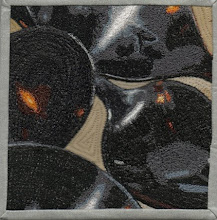
Onto the bowl with skeleton keys, I've quilted the first two lines of the second stanza above. "Lose something every day, accept the fluster of lost door keys, the hour badly spent."

Like my Poe postcard, I've edged the card instead of binding it. I've used a twisted cord for this one, but I found it more difficult to splice than the silk rat tail that I used for Poe. If anyone has perfected this technique and wants to share their tips, I'd love to hear them.